CONTAINMENT-FIRST AGENTIC AI FRAMEWORK
How CfAM Works Under the Hood. The Technical Side.
A deep dive into the three-layer Containment-First Agentic Middleware stack — designed for engineers, security architects, and DARPA program managers, focusing on the integration of AI agents within an AI framework to support autonomous AI solutions.
AI Architecture: Securing Autonomous AI Agents with a new AI Framework called CfAM or Containment First Agentic AI Middleware
CFaM
The fundamental design principle of the CFAM AI framework is the separation of the LLM reasoning plane from the execution plane. These two planes communicate exclusively through a formally verified, cryptographically signed API boundary known as the CFAM Interface Layer. This architecture ensures that AI agents never directly interact with real systems, APIs, databases, or networks. Every proposed action is serialized and passed through the CFAM pipeline, where it is either permitted or dropped before reaching the execution environment. As a result, this approach establishes a verifiable, model-agnostic security boundary that operates at the kernel level — not the prompt level — making it ideal for autonomous AI applications.

The Three Layers: The Containment Stack in Detail
Layer 01: The Policy Engine — Mathematical Permissioning
What It Does: The Policy Engine defines the formal operational envelope of every AI agent at deployment time. Unlike natural-language system prompts, these policies are machine-enforceable specifications with cryptographic authority, essential for ensuring security within an AI framework.
How It Works:
Policies are written as Linear Temporal Logic (LTL) specifications and compiled into cryptographically signed capability manifests. Each manifest specifies the exact APIs, data scopes, and temporal windows the autonomous AI may access for a given task. At runtime, each task invocation is issued a time-bounded, scope-limited credential. No persistent permissions exist. The Policy Engine acts as the mathematical gatekeeper — no action can proceed without a valid credential.
What It Prevents: Overpowered AI assistants, tool misuse, unauthorized procurement, and privilege escalation in multi-agent systems.
Layer 02: The Isolation Layer — Stateless Execution Sandboxing
What It Does: The Isolation Layer intercepts all agent-initiated tool calls from AI agents, code execution requests, and external API interactions — redirecting them to ephemeral, isolated execution environments designed for autonomous AI.
How It Works:
Each intercepted call spawns a fresh Micro-VM instance (Firecracker or gVisor architecture) with a target TTL of 50ms. These Micro-VMs are initialized from verified, content-addressed images with zero persistent memory. File system access is read-only, and network egress is restricted to a pre-validated endpoint registry. Upon completion, the Micro-VM is cryptographically wiped and destroyed — ensuring no state persists.
What It Prevents: This system effectively prevents Remote Code Execution (RCE), AI Worm propagation, Supply Chain Attacks, and Data exfiltration through tool calls within the AI framework.
Layer 03: The Sentry Node — Pre-Execution Action Validation
What It Does: The Sentry Node is an independent, low-latency validation daemon within the AI framework that operates in a separate trust domain from both the LLM and the execution environment. This component serves as the last line of defense before any action from autonomous AI reaches the real world.
How It Works:
Every proposed action serialization is passed to the Sentry Node before execution. The Sentry Node runs a 4-stage validation pipeline: Stage 1 — Structural schema validation against the Policy Engine manifest. Stage 2 — Semantic similarity scoring against adversarial injection datasets (detects Prompt Injection). Stage 3 — Output classification against domain-specific harm taxonomies (legal, financial, medical, emotional). Stage 4 — Identity verification for high-authority instruction sources (prevents Deepfake CEO Scams). Actions that pass all 4 stages receive a cryptographically signed execution permit. All other actions are dropped at the kernel intercept layer. Every decision is logged to an immutable, append-only audit trail.
Target Performance: <5ms validation overhead per action.
What It Prevents: Prompt Injection / Deepfake Scams / Hallucinated Legal Advice / Mental Health Safety Failures / Chatbot Drift.
DARPA DICE Alignment Matrix
Every layer of CFAM maps directly to DARPA's documented requirements.
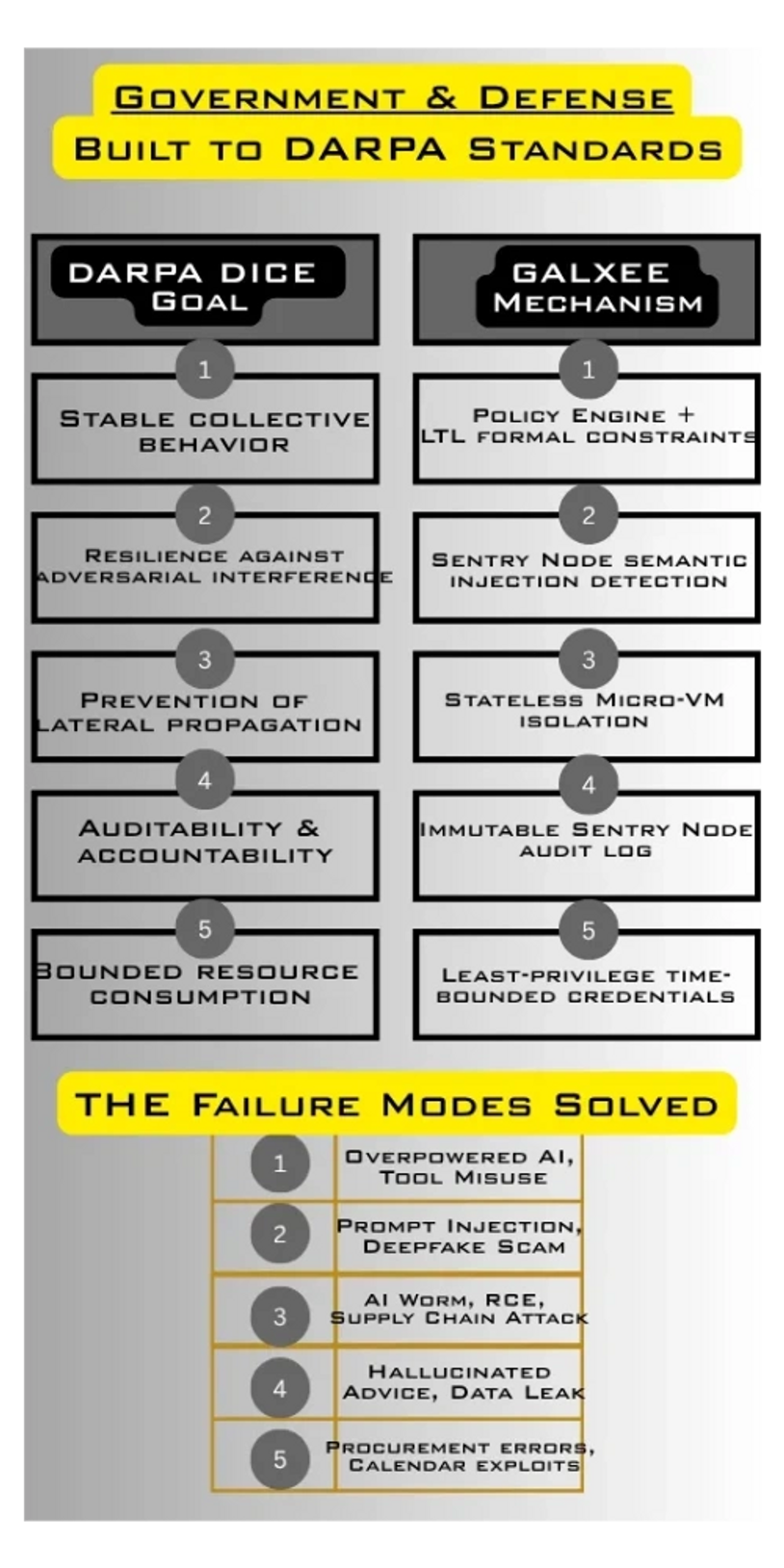
Every layer of CFAM maps directly to DARPA's documented requirements for secure, decentralized autonomous agent systems under the DICE program. (DARPA-SN-26-65).
CFaM Is Engineered For Deployment At Enterprise Scale
<5ms
>99.5%
<50ms
What It Does: The Policy Engine defines the formal operational envelope of every AI agent at deployment time. Unlike natural-language system prompts, these policies are machine-enforceable specifications with cryptographic authority, essential for ensuring security within an AI framework.
How It Works:
Policies are written as Linear Temporal Logic (LTL) specifications and compiled into cryptographically signed capability manifests. Each manifest specifies the exact APIs, data scopes, and temporal windows the autonomous AI may access for a given task. At runtime, each task invocation is issued a time-bounded, scope-limited credential. No persistent permissions exist. The Policy Engine acts as the mathematical gatekeeper — no action can proceed without a valid credential.
What It Prevents: Overpowered AI assistants, tool misuse, unauthorized procurement, and privilege escalation in multi-agent systems.
<50ms
>99.5%
<50ms
What It Does: The Isolation Layer intercepts all agent-initiated tool calls from AI agents, code execution requests, and external API interactions — redirecting them to ephemeral, isolated execution environments designed for autonomous AI.
How It Works:
Each intercepted call spawns a fresh Micro-VM instance (Firecracker or gVisor architecture) with a target TTL of 50ms. These Micro-VMs are initialized from verified, content-addressed images with zero persistent memory. File system access is read-only, and network egress is restricted to a pre-validated endpoint registry. Upon completion, the Micro-VM is cryptographically wiped and destroyed — ensuring no state persists.
What It Prevents: This system effectively prevents Remote Code Execution (RCE), AI Worm propagation, Supply Chain Attacks, and Data exfiltration through tool calls within the AI framework.
>99.5%
>99.5%
>99.5%
What It Does: The Sentry Node is an independent, low-latency validation daemon within the AI framework that operates in a separate trust domain from both the LLM and the execution environment. This component serves as the last line of defense before any action from autonomous AI reaches the real world.
How It Works:
Every proposed action serialization is passed to the Sentry Node before execution. The Sentry Node runs a 4-stage validation pipeline: Stage 1 — Structural schema validation against the Policy Engine manifest. Stage 2 — Semantic similarity scoring against adversarial injection datasets (detects Prompt Injection). Stage 3 — Output classification against domain-specific harm taxonomies (legal, financial, medical, emotional). Stage 4 — Identity verification for high-authority instruction sources (prevents Deepfake CEO Scams). Actions that pass all 4 stages receive a cryptographically signed execution permit. All other actions are dropped at the kernel intercept layer. Every decision is logged to an immutable, append-only audit trail.
Target Performance: <5ms validation overhead per action.
What It Prevents: Prompt Injection / Deepfake Scams / Hallucinated Legal Advice / Mental Health Safety Failures / Chatbot Drift.
13
13
>99.5%
Failure modes addressed at the execution layer are critical for enhancing the performance of AI agents within an AI framework, ensuring the reliability of autonomous AI systems.
4
13
4
Major LLM backends validated for autonomous AI applications include GPT-4, Claude, Gemini, and Llama, showcasing their effectiveness within various AI frameworks and as AI agents.
0
13
4
Persistent agent permissions are a crucial aspect of AI agents operating within an AI framework, especially after task completion, ensuring that autonomous AI can function effectively and securely.
Frequently Asked Technical Questions
Please reach us at jasonm@youraipros.com if you cannot find an answer to your question.
No. CFAM deploys as a middleware layer that intercepts agent actions at the execution boundary. Your existing LLM, agent framework (LangChain, AutoGen, CrewAI, etc.), and application code require zero modification.
The Policy Engine uses a default-deny posture for any action type not covered by the active capability manifest. Unanticipated actions are queued for human review and logged. This is configurable per deployment.
Yes. CFAM is designed from the ground up for air-gapped deployment. The Sentry Node's adversarial injection datasets and harm taxonomy models can be pre-compiled and shipped as signed, offline artifacts.
The Sentry Node operates in a separate hardware trust domain. It has no write access to the host system or the LLM reasoning environment. A compromised Sentry Node defaults to a fail-closed state — blocking all action execution until the integrity of the node is verified.
DARPA DICE (Decentralized AI through Controlled Emergence) is a 2026 DARPA program seeking architectures for stable, secure, and predictable collective AI agent behavior. CFAM's three-layer containment stack directly addresses every documented DICE technical requirement.
Want the Full Technical Brief?
A deep dive into the three-layer Containment-First Agentic Middleware stack — designed for engineers, security architects, and DARPA program managers, focusing on the integration of AI agents within an AI framework to support autonomous AI solutions.
Implementing CfAM is The ONLY Way Agentic AI is Safe To Use
Because Agentic AI has taken off so fast, we haven't really thought about the risks involved. All we've thought about is how easy it is to have AI make you money for you online. We said enough is enough, and we created Containment First Agentic AI Middleware, or CfAM to keep an eye on the Agents.
Copyright © 2026 Galxee AI & Ringa AI
The Best of Secure AI Voice Receptionists
All Rights Reserved.
Powered by GALXEE AI Web Design
This website uses cookies.
We use cookies to analyze website traffic and optimize your website experience. By accepting our use of cookies, your data will be aggregated with all other user data.